

Muweilah is an Iron Age settlement located approximately 15 km from Sharjah’s present-day coastline and about 45 km from the inland plain of Al Dhaid. During its ancient occupation, the site may have been situated near a shallow lagoon or creek connected to the coast. The region’s climate during that period was probably similar to that of today, characterised by hot summers, warm winters, and very low rainfall.
Since 1994, the site has been excavated by archaeological missions from Australia, Europe, and the United States, in collaboration with the Sharjah Archaeology Department. The excavations and surveys have revealed a settlement that has fundamentally changed our understanding of the later prehistoric period in the United Arab Emirates.
The site was primarily occupied during Iron Age II (1000–600 BC), following Iron Age I (1300–1000 BC), a period that witnessed a rapid increase in the number and size of settlements across the region. Muweilah represents one of the most significant examples of this settlement expansion, although it differs from contemporary settlements in several respects.
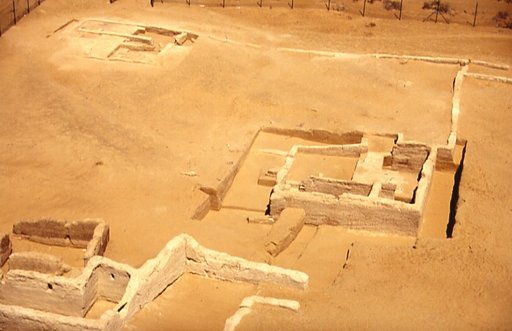
A surrounding wall encloses the central settlement, within which at least seven buildings with distinct functions have been identified. Some were used for residential purposes, while others served as storage facilities. Building 2 may have functioned as the settlement’s administrative centre. It consists of a large central room containing 20 column bases, along with several smaller rooms. These rooms yielded numerous painted vessels, spouted jars, iron weapons, and hundreds of bronze objects, indicating the presence of a bronze-working workshop.
Imported goods from Iran and Mesopotamia have also been discovered, highlighting the growing importance of trade, which was partly facilitated by the domestication of the camel during this period. Contacts with Yemen were particularly significant for the incense trade. Furthermore, the discovery of a pottery fragment bearing three Sabaean script lines—considered the earliest writing discovered to date in the United Arab Emirates—provides further evidence of connections with Yemen.
Related Sites
Al Thuqeibah Site
Masafi 1 Site
Masafi 3 Archaeological Site