

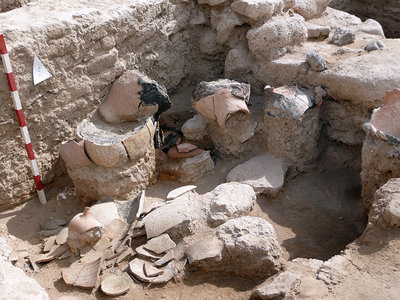
Mleiha Settlement is located on an inland plain west of the Hajar Mountain range, approximately 20 km south of the modern city of Al Dhaid and 50 km east of Sharjah. The first archaeological excavations at Mleiha were carried out by an Iraqi archaeological mission in 1973. From 1985, a French team undertook excavations at the site during annual seasons that continued until 1999. Since 1993, the local archaeological mission of the Department of Antiquities at the Sharjah Department of Culture and Information has also been responsible for excavations at the site and continues its work to the present day. The successive excavations at Mleiha have yielded significant discoveries, which are briefly outlined below:
Monumental Buildings
Recent archaeological excavations have revealed important structures at the Mleiha site. These include simple houses and large, multi-room buildings with internal courtyards. A building with a plaster-coated floor was also discovered and identified as a palace.
The fort is of particular importance. It is a large structure built of mudbrick in an approximately square plan, measuring 60 × 55 metres. It consists of a large central courtyard surrounded on all sides by rows of rooms. The fort appears to have served several functions, including residential quarters, storage rooms, and a metalworking workshop. It may also have served as a centre of political authority, as suggested by the discovery of coin-minting moulds inside the building.
Burials
A number of monumental tombs, graves, and significant grave markers have been discovered at the site. One of these grave markers bears the name of Oman. The burial structures also include multi-chambered underground tombs, as well as graves containing the remains of humans alongside camels and horses.
Some of the camels were hybrids of the Arabian one-humped camel (dromedary) and the two-humped Bactrian camel. One particularly remarkable discovery was a tomb containing a camel buried alongside a horse, the latter accompanied by its complete set of funerary equipment, consisting of ten gold discs.
Related Sites
Dibba Al Hisn Site
Dibba Communal Tomb