

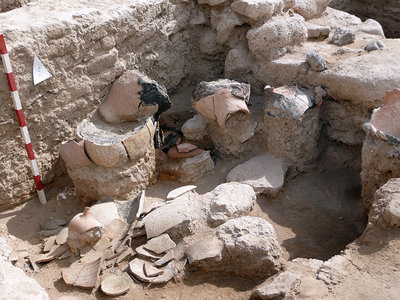
Ed-Dur is one of the largest archaeological sites not only in Umm Al Quwain but also throughout the Arabian Gulf. It represents an entire ancient city dating from the third century BC to the first century AD, which marks the main period of settlement. It is believed to be the port of Omana, mentioned by the Roman historian Pliny as one of the most important ports in the Arabian Gulf.
A major building was discovered and excavated by Professor Ernie Haerinck of Ghent University in Belgium. It was identified as a temple dedicated to the Semitic god Shamash, based on a basin found inside it and an inscription bearing the name Shamash in Aramaic. The building is distinguished by its square shape, measuring 8.30 × 8 metres. Its exterior walls were expertly coated with plaster, and its entrances were decorated with ornamental designs.
A massive stone block found at the centre of the building, believed to have originally come from a tomb dating to the Umm Al Nar period, has been described as a possible altar. Three additional, smaller altars constructed from locally available coastal rocks stand outside the building. Nearby, a circular, stone-lined well was discovered, reaching a depth of six metres.
The site also contains a square-shaped fort with round towers at each corner. Inside the fort is a separate, nearly square building comprising two rooms, along with another enclosure constructed opposite the eastern wall.
A remarkable number of individual and communal tombs are scattered throughout the site, among the residential buildings.
Related Sites
Dibba Al Hisn Site
Dibba Communal Tomb