

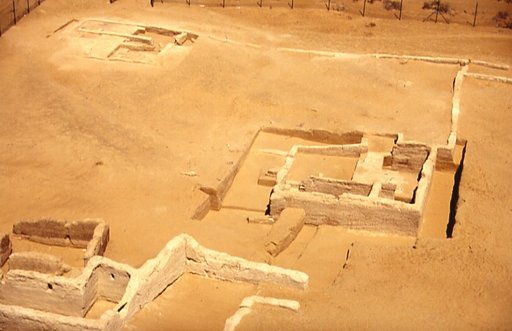
Part of the site is occupied by the modern Al Qusais Cemetery, where archaeological excavations first began in 1974 following the discovery of several archaeological artefacts during the digging of modern graves. These finds included conical stone vessels bearing beautiful engraved designs, several arrowheads, and fragments of bronze and pottery vessels.
The results of those excavations led to the discovery of a number of individual tombs, two large rectangular communal burial tombs, and a small temple that appears to have been dedicated to the worship of snakes. These structures were dated to the second and first millennia BC.
Archaeological excavations resumed between 1990 and 1994, when the local archaeological team worked within the boundaries of the present-day Al Qusais Cemetery, along its southern wall. The objective was to determine the boundaries of the archaeological site and separate it from the modern cemetery, ensuring that future expansion of the cemetery would not encroach upon the archaeological area.
During these excavations, the local archaeological team discovered two burial fields that differed significantly in shape, size, excavation methods, burial practices, tomb orientation, and the types of artefacts found. These differences may reflect changes in the beliefs and burial customs of the people who inhabited Al Qusais during the second and first millennia BC. The evolution and transformation of human civilisation likely resulted in distinct burial traditions among different communities, shaped by varying religious beliefs, social structures, family organisation, settlement patterns, and ways of life. These differences were also influenced by population density, the types of crafts practised, and the nature of external trade and political relations.
A total of 120 tombs were discovered during the 1990–1994 excavation seasons. They date from the second half of the second millennium BC through to the second Iron Age period and were found at depths ranging from 40 to 150 cm below the site's surface.
Related Sites
Al Thuqeibah Site
Muweilah Site
Masafi 1 Site