

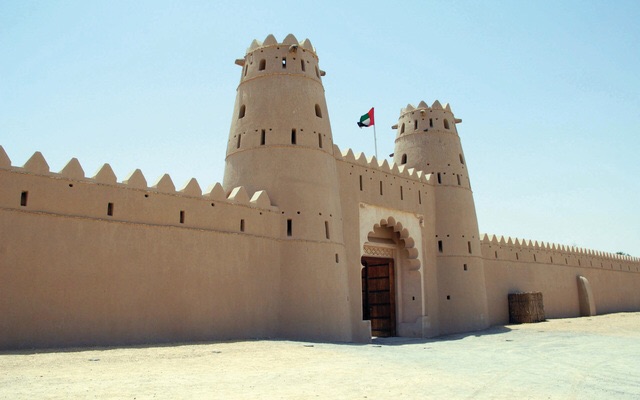
The Al Jahili Fort complex contains several elements of traditional mud-brick architecture that are also preserved in other parts of Al Ain. These include a circular watchtower, a square fort with defensive towers at its corners, a perimeter wall, and a mosque. Recent works have also uncovered the remains of a falaj, or a covered irrigation channel.
The oldest parts of the fort are the freestanding, multi-storey circular tower and the inner fort. The circular tower may predate the square fort, which was originally the only watchtower of its kind built to protect the Al Jahili Oasis. An inscription above the southern entrance indicates that the square inner fort dates back to the 1890s, when it was built by Sheikh Zayed the First (1855–1909). The inscription bears the name of Sheikh Zayed, the fort’s founder:
“Good fortune has opened the gateway to glory, bringing happiness to this lofty and noble place.
The congratulations of glory proclaim the date: a house of grandeur built by Zayed bin Khalifa.”
In the early 1950s, Al Jahili Fort was used as a base for the Trucial Oman Scouts. Accommodation for the troops and storage facilities were added, arranged in units around the fort’s courtyard. The circular tower was initially used as a guard post but was later converted into an officers’ post.
Restoration work carried out between 1986 and 1989 included the removal of some buildings associated with the British administration and the creation of a large courtyard, which is now used for public events and music festivals. The present imposing entrance, flanked by large towers, was added during this period, along with a hall and passageways forming the western end of the courtyard. All the new structures added during the 1950s were built using the same traditional mud-brick wall construction and palm-trunk roofing as the original buildings.
These newer elements underwent a restoration project between 2007 and 2008, led by the Abu Dhabi Authority for Culture and Tourism. Some areas were converted into exhibition spaces, including a permanent photographic exhibition featuring the British explorer Wilfred Thesiger, while others were developed into an information centre for visitors to Al Ain.
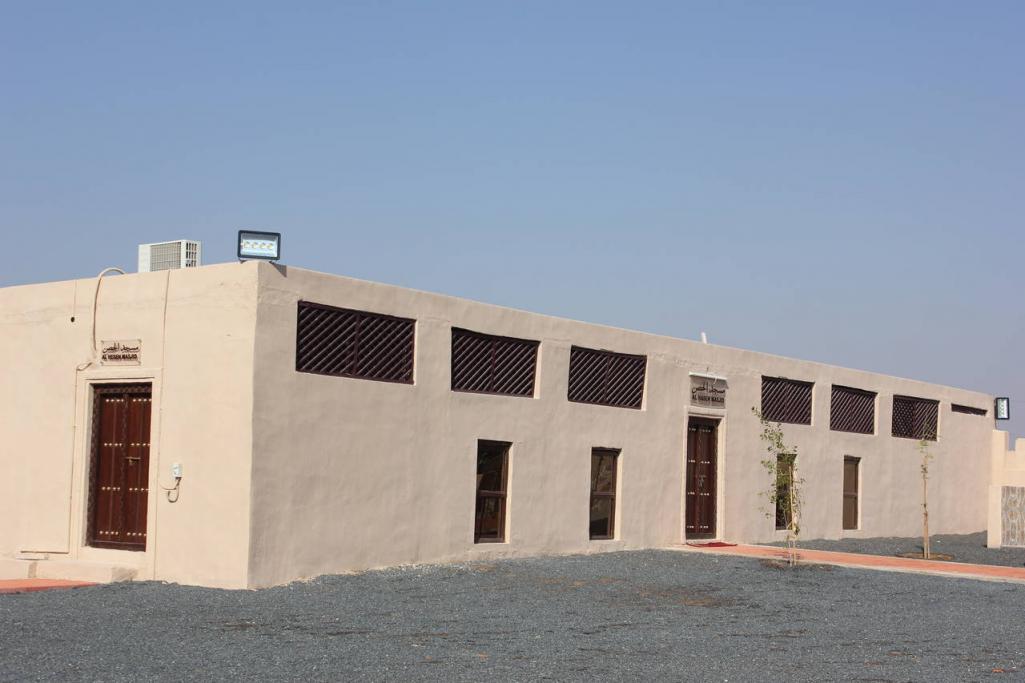
To the south of the fort stands a small mosque, probably contemporary with the inner fort built by Sheikh Zayed the First. The mosque consists of a single room with open passageways on its eastern side. It is accessed through an enclosed courtyard, which is covered during the summer to provide additional shade. Inside the courtyard, there is a low platform used for the call to prayer and a small room that may originally have served as a place for ablution.
Related Sites
Falaj Al Mualla Mosque

Al Shariah
Bin Halees Tower