

Al Shabih
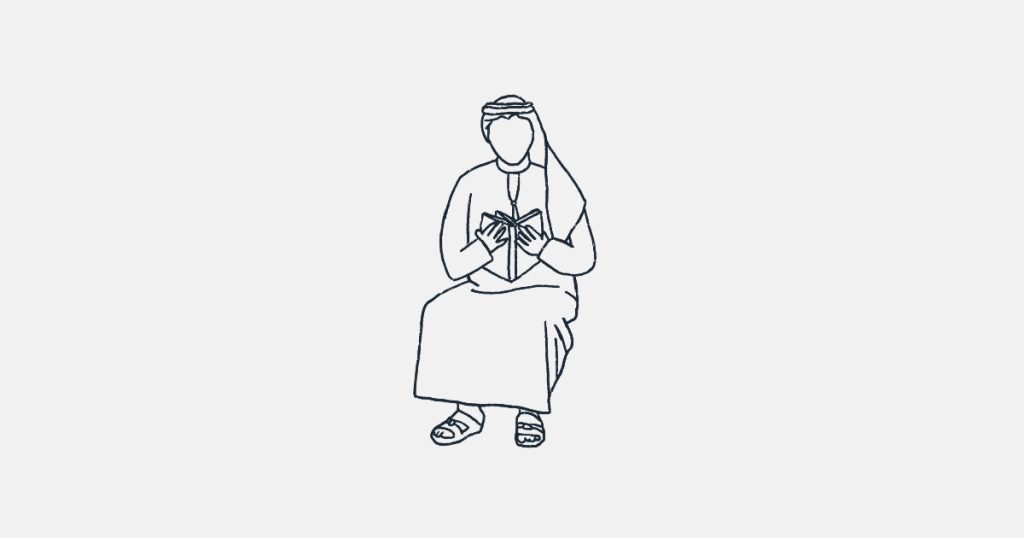
Al Shabih is described as a handsome young man of fine appearance: elegant, tall and slender, fair-skinned, fond of reading and learning, eager to confront difficulties and uncover strange things. He likes to hide himself from people and is particularly shy around women.
The other side of his character, however, is ugly and deformed: he is crippled and disabled and can move only with great difficulty.
This strange figure was said to walk on all fours, placing tin cans over his hands to prevent them from becoming dirty, with pieces of cloth wrapped around the rim of each can. Others say that he placed earthenware vessels known as barmah, on his hands and walked using them.
Many years ago in Ajman, there lived a handsome young man of fine appearance, elegant and well dressed, tall and slender, fair-skinned, fond of confronting difficulties and discovering strange things, and passionate about reading. Among the most important books he devoted himself to studying were works on magic and sorcery. One of the best-known such books in the UAE at the time was the work commonly called Kitab Al Ghazali, entitled Shams Al Ma'arif Al Kubra. Another book also attributed to Al Ghazali and used by practitioners of sorcery was Al Khatam Al Sulaymani wa Al Ilm Al Ruhani, while other famous works in this field included Kitab Abi Ma'shar Al Falaki Al Kabir.
After immersing himself in these books and others, Al Shabih began spending time with practitioners of magic and sorcery and visiting their homes. He also attended houses where zar sessions and rituals intended to expel jinn and devils from possessed people were held.
As he became increasingly absorbed in these strange actions and practices, people distanced themselves from him and he began avoiding them in return. Having once been the dream of young women because of his handsome appearance, he became frightening, ugly and strange to everyone around him.
Narrators say that after Al Shabih finished reading the books mentioned above and continued visiting the homes of sorcerers and practitioners of magic, he cut himself off from people, withdrew from society and lived in a ruin at the edge of the town. He remained there for a long time, feared light and avoided mixing with people.
During the period Al Shabih spent in the ruin away from others, his features changed. He went from handsome to hideously ugly and soon became crippled and unable to walk or move normally.
A story then spread among people that when he moved into the ruin, a female jinn had “taken him as a husband,” as expressed in the local vernacular. According to the tale, she transformed him into a disabled, deformed figure so that human girls would no longer be attracted to him, while in the evening he returned to the form of a healthy, strong man so that he could live with her as her husband.
Some people therefore said that Al Shabih lived with two personalities: the first was the ugly disabled figure seen during the day, while the second was the handsome, elegant and strong young man who appeared in the evening. The first was for people, and the second for his jinn wife.
People wondered where Al Shabih lived as husband and wife with the female jinn until they came to believe that he went with her underground to a beautiful house built as their subterranean marital home.
The strangest aspect of Al Shabih’s story was that he did not work or earn any income, yet his table was always filled with delicious food and drink. He still needed to eat and drink because he was originally human and could not live without food even if he had connections with the jinn. People found this puzzling.
Who, then, brought Al Shabih his food and drink? They eventually came to believe that his jinn wife had assigned jinn servants to fulfil his needs, serve him and provide him with the food and drink he required.
One narrator says: “We would pass by and find fish hanging from a rope beside his hut, already cleaned and covered in salt, and we did not know who had done it. He was physically incapable of doing this himself, and the work required more than one person, which was puzzling to us.”
It was also said among the people that Al Shabih’s relationship did not end there: he had sons and daughters with the female jinn, and they lived with him in the hut he built beside a large sidr tree. The cats constantly circling his hut were believed to be his children.
One narrator says: “Sometimes we passed beside his hut and heard him talking to strangers in a language we did not understand. Then he would stop speaking and open the door of the hut, but nothing would emerge except cats. We therefore knew that he had been speaking to them—that he had been speaking to his children in their jinn language, which they understood.”
Al Shabih is both reality and folklore at the same time: real in terms of his existence in a particular place and period, his suspicious dealings with magic and his association in one way or another with the world of the jinn; and mythical in what was added to his story over time, much of which reason and logic cannot accept. Al Shabih nevertheless remains a creation of the Emirati popular imagination and a distinctive figure in the folk literature of the UAE’s cultural heritage.